
Menard County Projected Versus Actual Release
TDCJ defines a projected release date as the date calculated by its Classification and Records Office when a confined person is expected to leave incarceration if parole does not occur first. It is a forecast under the controlling sentence rules. A scheduled release date is a more advanced administrative date after release processing, yet it can still change. The actual release date records when custody truly ended or moved to supervision.
Menard County Jail uses a different path. A pretrial booking does not create a calculated sentence-release date. Bond, a court order, a hold, dismissal, or transfer can determine departure. A person serving a short local sentence may have an expected end date, but no Menard-specific public calculation policy or online date field was found. Ask the Sheriff for the release entry and the court for the judgment and credit orders.
Find a Menard County Release Date
Start with the booking or prison identifier. Do not apply a TDCJ projected date to a county bond case, and do not ask the Sheriff to calculate a state-prison sentence. The custody source controls the next step.
- Call the Menard County Sheriff at 325-396-4705 with the full name, a second identifier, and the approximate booking date. Ask whether the person is held, released, or transferred.
- For a pretrial or county-sentence case, obtain the booking-release entry and the signed court orders. Ask for the release date and time, release code, authority, and any receiving agency.
- If the Sheriff reports a TDCJ transfer, open the official TDCJ inmate search and use the TDCJ or SID number. Name-only matches need careful comparison.
- Read projected release, maximum sentence, parole-review, offense, county, and current location fields together. Note the update time.
- Use TDCJ’s email or Classification and Records fallback when the public result is missing, unclear, or no longer current.
- Register through the correct IVSS service for notice, then confirm the completed release with the source agency.
The Menard County release-record path gives the broader steps for matching the Sheriff entry to the court cause and any receiving system.
Menard State-Prison Date Fields
The TDCJ online search covers people currently incarcerated in a TDCJ facility. Search with the unique TDCJ or SID number whenever possible. If only a name is available, compare age or date descriptors, sex, race, offense, county of conviction, and sentence before accepting a match. Menard is the county of the case, not necessarily the location of a prison unit; no TDCJ unit was identified inside the county.
| Field | How to read it |
|---|---|
| Projected release date | TDCJ’s current calculation of expected departure if parole does not occur sooner |
| Maximum sentence date | The sentence-expiration endpoint, often later than a parole release |
| Parole review information | A Board process milestone, not proof of physical release |
| Current location or status | The reported TDCJ custody setting as of the update time |
| Scheduled release | A planned processing date that remains subject to final checks and holds |
TDCJ data are updated on working days and are at least 24 hours old. The current locator is not a released-prisoner archive. If the person disappears, request the actual release or discharge information rather than turning the no-result into a release claim.
Official Menard Release-Date Fallback
TDCJ’s official inmate-information email is pia@tdcj.texas.gov. Provide the full name and seven-digit TDCJ number. Without the number, give the exact birth date or approximate age and county of conviction. Specify the fields needed, such as current offense and court, location, incarceration history, projected release date, maximum sentence date, or release information. TDCJ says the limited email information service is free.
For time, custody, transfer, and scheduled or actual release issues, contact TDCJ Classification and Records at 936-437-6231 or classify@tdcj.texas.gov. A formal Public Information Act request can go to PIA@tdcj.texas.gov or P.O. Box 4017, Huntsville, TX 77342. Costs and legal exceptions may apply. A focused request tied to a TDCJ number and date range is easier to process than a broad question.
The official TDCJ inmate-information page lists the available fields and explains the projected date.
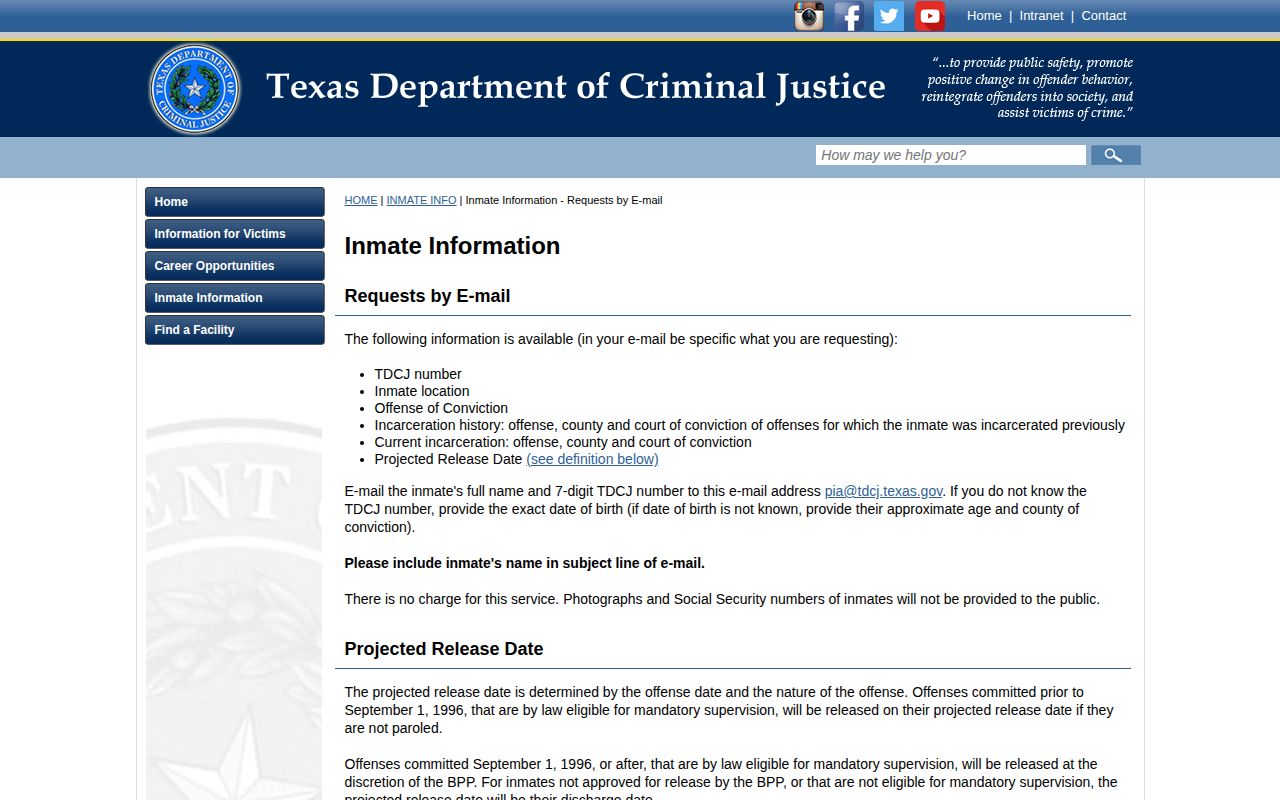
The captured page shows why the official email route is a useful fallback when a current online result does not answer the date question.
A complete state-date inquiry should preserve the offense date, judgment, county and court, sentence length, TDCJ number, projected date, maximum date, and parole-review fields. Offense date matters because Texas parole and mandatory-supervision law changed over time. If the public result and signed judgment appear inconsistent, provide both to Classification and Records rather than trying to correct the date independently.
For a Menard jail sentence, request a different record set. Ask for the judgment, credit for time served, commitment received by the Sheriff, and final release entry. “Time served” can describe a court sentence, a jail code, or an informal summary. Matching the cause number, booking number, and signed orders shows which meaning applies.
Texas Public Information Act timing also needs care. Government Code section 552.221 calls for prompt production without unreasonable delay. Ten business days is not a universal delivery promise; that period often concerns an agency request for an Attorney General withholding decision. If records cannot be produced in that period, the agency must provide the required certification and a reasonable production date. Ask for existing electronic records and a cost estimate when appropriate.
Texas Good Time for Menard Cases
Texas does not have a general rule that every prisoner must serve 85 percent of a sentence. The actual framework depends on the offense date, judgment, offense category, parole law, and eligibility for mandatory supervision. Broad percentage math can therefore produce a false date.
Texas Government Code section 498.003 governs good-conduct time. It states that good time affects eligibility for parole or mandatory supervision rather than reducing the sentence itself. For an eligible offense committed before September 1, 1996, flat calendar time plus good time may reach the sentence term and support mandatory-supervision release. For eligible later offenses, the Board reviews discretionary mandatory supervision. A denial can move the projected date toward the maximum expiration date.
Government Code sections 508.145, 508.147, and 508.149 address parole eligibility, mandatory-supervision release, and exclusions or review. Code of Criminal Procedure article 42A.054 identifies designated serious offenses and deadly-weapon findings relevant to actual-calendar-time rules. The law in effect for the offense and the exact judgment control. Good time cannot be treated as a fixed discount promised to every Menard defendant.
Why Menard Release Dates Change
A date can move even when the displayed calculation was accurate on the day it appeared. TDCJ recalculates as sentence data, earned credits, Board action, and legal holds change. County departure can also be delayed or redirected by a court order or another agency.
| Factor | Possible effect |
|---|---|
| Good-time earning or loss | Changes eligibility calculations but does not shorten the sentence itself |
| Parole decision | May permit earlier supervised release or leave the projected calculation in place |
| Mandatory-supervision review | Approval or denial can change the expected release path |
| New court order or corrected judgment | Can alter sentence data, credit, or authority to hold |
| Detainer, warrant, or hold | May shift the person to another custodian instead of the community |
| Release processing | Residence approval, programs, eligibility, and paperwork can affect scheduling |
A favorable parole vote is not a walk-out date. TDCJ Review and Release Processing still checks legal eligibility, residence placement, required programs, special conditions, and release papers. Preserve the displayed update date and recheck closer to the expected event.
County and state calculations require different source records. For a Menard jail sentence, collect the judgment, credit for time served, commitment received by the Sheriff, and final release entry. For state custody, retain the TDCJ number, offense date, projected and maximum fields, Board action, and actual release certificate. Never combine a county estimate with TDCJ good-time rules.
No Menard-specific jail good-time policy, weekend-release rule, release schedule, or public calculator was verified. Ask how a signed order was applied, but do not assume a local custom or create a date from incomplete facts.
No 85-Percent Menard Rule
The distinctive Texas rule is not a single percentage. Some article 42A.054 cases have actual-calendar-time floors for parole eligibility. Good time may count toward eligibility where the law allows, but it does not erase part of the judicial sentence. Mandatory supervision also differs based on offense date and exclusions.
Never calculate an individual date only from the sentence length or a news report. Obtain the judgment, offense date, credit order, TDCJ calculation, and current eligibility fields. If they conflict, Classification and Records is the agency that can explain the official computation. A court clerk supplies the signed orders but does not run TDCJ’s administrative formula.
The TDCJ definitions page explains projected release, maximum sentence, parole, and mandatory supervision in official terms.
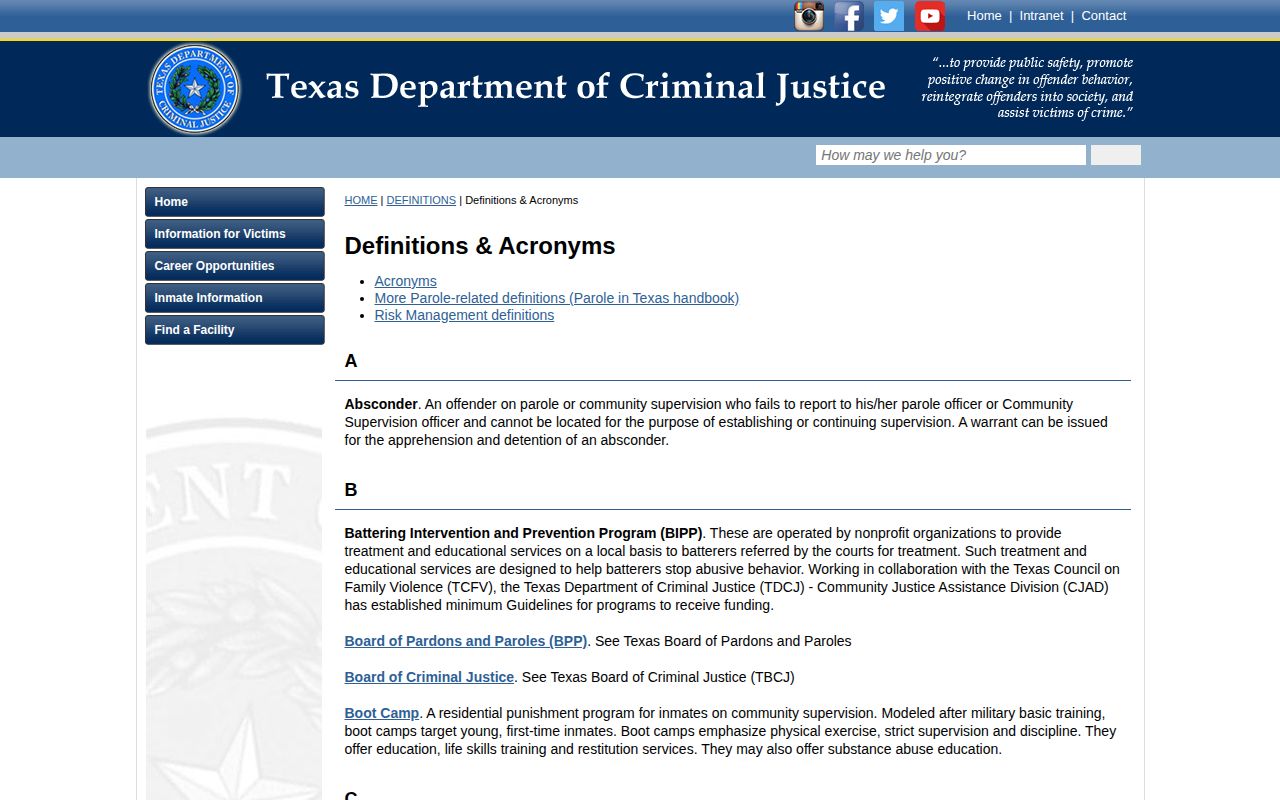
The state definition confirms that projected dates are calculated and may be revised, which is why an old screenshot cannot prove a future release.
Confirm Menard County Actual Release
For a county jail departure, ask for the Menard Sheriff booking-release sheet or jail-register entry. Match its booking number and release time to the court cause. “Transfer,” “TDCJ,” or another receiving agency means the Sheriff’s custody ended while detention continued elsewhere. A bond release ends that jail stay but does not resolve the case.
For TDCJ, use the actual release event, certificate, or Classification and Records response. TDCJ IVSS can notify subscribers about processing, release, discharge, and supervision events. IVSS-Counties applies to participating county events. The Menard County VINE inmate check explains the two current systems and the 2025 county transition.
A notification is not the final court disposition and a no-result is not a release record. Confirm any other hold named by the source agency. BOP, ICE, another county, and the U.S. Marshals each have different coverage, so the receiving-agency field matters as much as the date itself.
Record the date and time when each source was checked. TDCJ’s working-day updates are at least 24 hours old, so a displayed location can trail the actual event. If release timing matters, compare the later certificate or records response with the earlier projected and scheduled fields. The final record should identify whether the person entered parole, mandatory supervision, direct discharge, or another custodian.